Innovative designs for small bathrooms

Using ideas and creativity to produce practical designs for small bathrooms

Have you recently stumbled across an article in a lifestyle magazine claiming there is an ongoing exodus from big cities? In fact, this is far from reality. Across the EU, around 75 percent of people live in urban centres – and have no plans to move away from them.

Wellbeing doesn’t need a lot of space: design ideas for small bathrooms

There are more shops and cultural facilities, the commute to work is shorter and services, from doctors to tradespeople, are more accessible. It’s therefore no wonder that living space in our cities is becoming ever scarcer and more expensive. Hamburg has a 0.5 percent vacancy rate, Amsterdam needs another 200,000 homes and in Paris, property costs an average of over EUR 30 per square metre. In many homes, the first thing to suffer due to this lack of space is the bathroom, with people often seeing no merit in sacrificing space and money on a room that is only used for a few minutes a day. What many landlords and property owners are overlooking is just how important a bathroom can be to people. It is the place where they both start and end their day – their place of retreat and wellbeing. Homes are simply not enjoyable without a lovely bathroom.


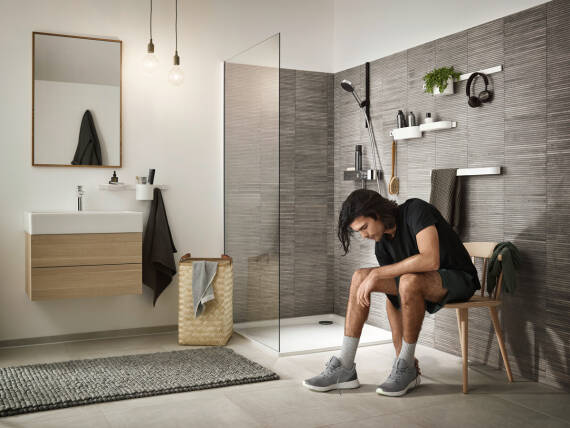
Floor-level shower, shelving on the wall.
A small bathroom with an ideal design and optimum space usage: floor-level shower with storage space under the wash basin and on the wall.

This article therefore reveals how to get the most out of even the smallest of bathrooms. From the basic planning through ideas on colour schemes and lighting design to details such as shelving and taps. Natascha Beha, product development and bathroom design expert at hansgrohe, accompanies us through the article.

We kick off the topic with the following question:

(Not) a matter of perspective: what classes as a small bathroom?

It goes without saying that size is relative. Ten square metres sounds like plenty of space for a bathroom, but if simultaneously used by five family members to get ready each morning, things quickly become cramped. Three square metres usually suffice for many singles, but if the user were in a wheelchair, a room of this size would be more than tight.

Despite this, we have used our wealth of experience to establish a general rule of thumb: bathrooms are generally challenging to plan and furnish if they have an area of less than five to six square metres. If this applies to your bathroom, our ideas for small bathrooms are sure to help.

Stylish small bathroom with a geometric wall design, warm colours and elegant details.
The geometric pattern and warm colours lend a modern look to this small bathroom. Stylish accessories and space-saving design ideas make it truly eye-catching.
Profile picture of Natascha Beha, hansgrohe bathroom expert.

Making small bathrooms feel homely is a truly complex interior design task. But with a little creativity, the right materials and premium accessories, anything is possible, even in the smallest of bathrooms.

Natascha Beha, hansgrohe bathroom expert.

Phase #1: planning a small bathroom

Whether you’re building a new, small bathroom or renovating an existing one, the planning process always begins with a drawing board – or to use a more modern approach, our 3D Inspirator tool. Even at this point, important questions arise that determine the course of the design.

Do you want a bath tub?

Although bath tubs can be installed in bathrooms with a size of just four square metres or more, they take up a huge amount of room. If you tend to shower rather than have baths, this is your biggest opportunity to reclaim some floor space. If, on the other hand, there’s no way you want to do without your beloved bath tub, we recommend either installing a shower over the tub or opting for a compact bath tub if you prefer to keep the two separate.

Do you want your toilet in the bathroom?

More and more people are keeping their bathroom and toilet separate. This is partly for purely practical reasons: brushing your teeth with your partner is an enjoyable part of your morning routine. The idea of brushing your teeth while your partner sits on the toilet, on the other hand, is somewhat less enticing. On the other hand, a separate toilet also saves a lot of space and creates room for additional comfort. If you have the opportunity to house your toilet in a separate little room of its own, you should therefore make the most of this. In households with more than one person, another question to ask yourself is whether you prefer a single or a double wash basin. The latter can often be regarded as almost indispensable, especially if multiple people need to use the bathroom at the same time each morning. If limited space is available, this requirement often determines whether people opt for a bath tub or a shower plus a double wash basin. As a positive side-effect, a double wash basin with a base unit automatically creates additional storage space to keep your bathroom neat and tidy.

Where should the lights be installed?

Another of the basic decisions when planning a bathroom is where to install the wiring. This is because once the electrical cables have been laid, retrospectively extending them is extremely complicated. You should therefore devise your lighting concept at an early stage.

Profile picture of Natascha Beha, hansgrohe bathroom expert.

One of the most common errors when designing a small bathroom is to have too little or the wrong lighting. Many people think that a single ceiling lamp suffices for a small room. In fact, quite the opposite is true. Small rooms in particular need a lot of light to come into their own.

Natascha Beha, hansgrohe bathroom expert.

Phase #2: big design ideas for small bathrooms

Once you’ve developed a basic plan, it’s time to consider the features and aspects of your bathroom that play a major part in its overall design and are relatively difficult to change. These include:

The materials

Mood board comprising beige tiles, a hansgrohe hand shower and tap in Brushed Bronze and warm-coloured textiles.

Let’s start with a basic point: small bathrooms particularly benefit from materials that generate an airy feel and visual calm. Lights ceramic tiles, porcelain stoneware and smooth mineral materials are good at reflecting light and make narrow rooms feel wider. Non-slip tiles or coverings with few joints are ideal for the floor (the fewer interruptions to the surface, the larger your bathroom appears). Natural materials add warm touches without overpowering the room. Light, matt lacquers or light wooden finishes, such as oak or birch, are ideal for vanity units and shelves, and make the room feel more homely. Contrasts should be used sparingly so the room doesn’t appear compacted. Let’s take a look at the finer details.

The shower

The shower is often the main eye-catching feature in a small bathroom. To make the room seem larger and harmoniously blend it into the overall design, the shower must not seem out of place. We therefore recommend opting for a floor-level, walk-in shower. This is because the lack of raised edges automatically makes the room feel larger. Such showers seem like an integral part of the bathroom, creating space rather than taking it up.

Spray protection

When thinking about your shower, it goes without saying that you should also consider how to keep the water in the shower cabin. Without spray protection, you’d have to get out your mop after every shower. In the case of small bathrooms, our advice is to avoid shower curtains and other opaque elements that take up room. Large shower screens made of glass or transparent plastic are ideal. These do not cast shadows or impair your view of the room, instead creating a greater sense of openness.

Tiling

Where water flows, tiles are never far away. There are two tricks for using your tiling to achieve maximum spatial effect in a small bathroom:

Stylish small bathroom with a geometric wall design, warm colours and elegant details.
The geometric pattern and warm colours lend a modern look to this small bathroom. Stylish accessories and space-saving design ideas make it truly eye-catching.

Large tiles are popular but not imperative. What matters more is which areas you tile and to what extent. As a general rule of thumb, the fewer tiles the better as the continual alternation between the grout and the ceramics can make the room seem smaller. You should therefore vary your usage: the tiles should come to at least 15 cm above the wash basin and we recommend tiling to a height of 130 to 150 cm in the toilet area and at least 200 cm around the shower and bath tub. The remaining wall areas should simply be painted or decorated with waterproof wallpaper.

Profile picture of Natascha Beha, hansgrohe bathroom expert.

The areas you tile and the extent to which you do so are more important than the size of the tiles. Bathrooms with a mixture of tiled and painted walls look far more modern and homely than fully tiled ones.

Natascha Beha, hansgrohe bathroom expert.

But even more important than the tiles themselves is the way in which they are laid: vertical lines can optically stretch a room (a principal you may remember from school art lessons). This means you should avoid all interruptions to the linear design; patterns and asymmetrically arranged tiles are a no-go if you want your bathroom to seem larger.

Colours

When talking about tiles, we naturally also need to discuss colours – not just of the tiles themselves but also of your bathroom as a whole. The rule here is very simple: light colours make rooms seem larger whereas dark ones are more oppressive and make spaces feel smaller and more confined. Of course, this doesn’t mean that white is your only option. Pastel shades or a soft blue are also ideal. Shades of green such as sage green, grey green or olive green look harmonious and natural, and are currently very much on trend. Or what about shades of beige or greige? These are soothing yet less sterile than pure white. The only thing we truly advise against is decorating your bathroom completely in black as you’ll feel like you’re in a cave when showering.

Profile picture of Natascha Beha, hansgrohe bathroom expert.

A light-coloured floor in particular makes your bathroom feel more spacious. In the ideal case, even the shower mat should be tone-on-tone.

Natascha Beha, hansgrohe bathroom expert.

Zoning

A further factor that is closely linked to your bathroom’s colour scheme is its zoning. What do we mean? Let us explain:

Visually dividing your bathroom into clearly identifiable areas makes it seem larger. For example the wash basin area, the shower area and possibly even the toilet area. The main way to achieve this effect is through the use of accent colours. Don’t just run riot and go for starkly contrasting colours though as this would achieve the exact opposite and establish the areas as constricted, stand-alone zones. Instead, go for calm, monochrome colours that work in harmony with the rest of the bathroom and only subtly stand out.

Having too many dominating elements destroys the overall effect of your small bathroom. According to Natascha Beha, clean lines, subtle patterns and harmonious colours are key.

Shelves

One last tip before we move on to the finer details of your small bathroom: plan your shelf space from the outset. After all, your shampoo and loofah sponge have to go somewhere. We aren’t talking about shelves in cupboards or sideboards here, but about wall alcoves and similarly hidden shelf space options that you can integrate into your bathroom. Creating this naturally needs some minor structural work but shouldn’t be any real trouble for experienced tradespeople. The amount of space you can gain is often astonishing.

Phase #3: little things with a big impact

Last but not least, we come to everything that is easy to change retrospectively. If you’re simply looking to give your bathroom a bit of a make-over without fully renovating it, you’re in the right place. The following add the final touches to your small bathroom:

Stylish small bathroom with a geometric wall design, warm colours and elegant details.
The geometric pattern and warm colours lend a modern look to this small bathroom. Stylish accessories and space-saving design ideas make it truly eye-catching.

Clever furniture

Storage room in a bathroom is important. This is because even when you’re not using them, your hair dryer, grooming items and hair straighteners still need to go somewhere – ideally within easy reach. While small bathrooms rarely have enough floor space for a large towel cupboard, they will always fit a vanity unit. We recommend choosing a model with drawers. This prevents the potential headache of bulky doors colliding with walls or the toilet due to the lack of space. You also won’t need to get down on all fours because someone has stored the toothpaste at the back of the cupboard again.

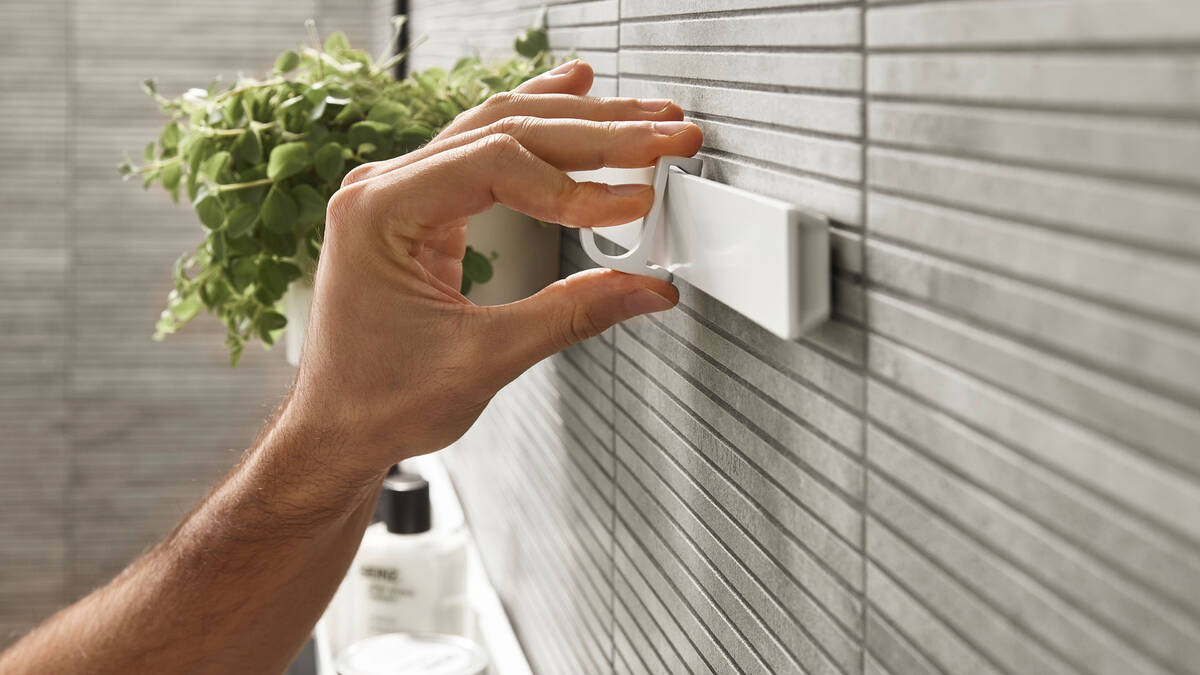
hansgrohe WallStoris as a shelf option in the shower.

Carefully designed storage systems

Not everything in your bathroom should be stored in cupboards; some things should be more easily accessible, whether shampoo for regularly washing your hair or your toothbrush for brushing your teeth twice a day as per your dentist’s recommendation. A modular storage system can save a great deal of space and blend naturally into your bathroom, offering convenient shelves for almost all of your body care essentials – from towels to toilet paper.

Profile picture of Natascha Beha, hansgrohe bathroom expert.

With the right accessories, there’s no need to compromise when it comes to style, practicality and convenience.

Natascha Beha, hansgrohe bathroom expert.

Shower rails with a shelf

You can create even more space for shampoo and shower gel by opting for a shower system or thermostatic mixer with a shelf. With the bracket doubling up as an easy-to-reach place for toiletries, when you’re enjoying the blissful sensation of the hot water pattering on your head and have let your thoughts drift away, you don’t even need to open your eyes to find the soap. Simply reach out without looking and continue dreaming while lathering up.

The right mirror

Hand operates sensor under hansgrohe Xarita Lite mirror.
Illuminated mirrors can often be controlled using contactless sensors.

But enough about storage space, another important bathroom accessory is a mirror. After all, your hair and make-up need to look perfect. The classic option is a mirror above the wash basin – in small bathrooms ideally combined with bright lights. But you shouldn’t restrict yourself to just one reflective surface; every additional mirror can make your bathroom seem larger. What about a wall-mounted, full-length mirror, for example? This has a huge visual impact and the practical benefit of allowing you to check what your entire outfit looks like. Or perhaps a ceiling-mounted mirror between the lighting fixtures to reflect the light more strongly? A make-up mirror, on the other hand, doesn’t make the bathroom seem bigger but is extremely useful for everyday routines. It can also be attached to a telescopic arm or alcove to make expedient and optimum use of all space available, even small corners.

Profile picture of Natascha Beha, hansgrohe bathroom expert.

Compact living space remains a global mega-trend. As such, bathrooms are evolving into places of mental regeneration where people can escape the stresses of city life.

Natascha Beha, hansgrohe bathroom expert.

High-quality, concealed models make the best shower mixers

Finally, all bathroom fixtures (except the toilet) naturally require a tap, as otherwise the water would run non-stop. We have two important pieces of advice in this regard: first, go for high-quality taps. These not only look and feel great but also feature precisely manufactured inner technology that offers everyday reliability. With taps used many times a day, good quality offers noticeable stability and minimises the risk of undiscovered dripping or leaks.

Whereas cheap products often wear out relatively quickly, brand-name taps generally offer far higher workmanship quality that pays off over many years. This will not only keep your bathroom looking great but also provide peace of mind from a technical perspective.

Profile picture of Natascha Beha, hansgrohe bathroom expert.

High-quality products pay off in many respects. Not only are they more durable, practical and suitable for everyday use, but they are also, and above all, a great way of adding special touches to small rooms.

Natascha Beha, hansgrohe bathroom expert.

In the case of small bathrooms, we also always recommend concealed taps. As indicated by the name, these are largely hidden behind the plaster, with nothing protruding annoyingly and conspicuously into your bathroom. All you can see are the taps’ operating elements – be that a large, practical handle or a small button, as per your personal preference.

Start thinking about tomorrow today

Our final hansgrohe tip: plan your bathroom so your grandchildren can benefit too. Not necessarily from the bathroom itself, but from the planet it is on. We are all responsible for sustainability.

Opt for water-saving shower systems, durable products and energy-efficient lighting. Your initial investment may be slightly higher than with a low-cost solution but it will quickly pay off. After all, it’s with good reason that ‘buy cheap, pay twice’ is a well-known adage.

Father and daughter in a hansgrohe family bathroom.
The WallStoris flexible storage system offers practical storage space in a small bathroom, can be customised and is easy to affix to any wall.

Plan your small bathroom online now

You’re now practically an expert when it comes to small bathrooms. From the initial design to the finer details, you know what to consider to get the most out of just a few square metres. So why not start planning right away?

Thanks to the 3D Inspirator tool on our website, you don’t even have to leave the house to do so. Simply select the basic shape of your bathroom and get started! From the colour scheme to the shower, wash basin, lighting and taps, the choices are entirely yours. Once your dream bathroom is ready, save the design and show it to a bathroom specialist – we’ll gladly recommend one near you. Bathroom planning really can be this simple.

Frequently asked questions about ideas for small bathrooms

When does a bathroom class as small?

There is no fixed threshold. It is not just the square meterage that matters, but also the room layout or whether there is a sloped ceiling. If you have four square metres or less to play with, however, you can generally refer to your bathroom as small.

What should you consider when starting to plan a small bathroom?

Always start with the layout and the following three questions:

  • Do you want a bath tub?

  • Is the toilet in the bathroom?

  • Where are the lights positioned?

The other steps should only follow once these aspects have been clarified.

What should I know when it comes to lighting in a small bathroom?

As a general rule, the more light you provide, the larger the room feels. Never restrict yourself to a single ceiling light; instead, go for spotlights as well as an illuminated mirror, light strips and other lighting fixtures.

Which colours are recommended for small bathrooms?

Small bathrooms particularly benefit from light colours as these make them appear larger. Accent colours should primarily be used for zoning purposes: making the wash basin, shower or toilet stand out through a subtle difference in colour creates a more spacious feel.

How should I tile a small bathroom?

The linear arrangement of the tiles is more important than their size. Interruptions to straight lines are visually intrusive and automatically make the room seem smaller. You should therefore avoid patterns and asymmetrically laid tiles.

What should I know about storage space and shelves in a small bathroom?

Multiple small storage systems are far better than a large, bulky cupboard where you can store everything at once. hansgrohe therefore offers numerous storage systems, from vanity units through shower rails with a shelf to modular systems for the walls.

Is there anything I should note when choosing taps for a small bathroom?

The same applies to small bathrooms as to larger ones: high-quality taps more than pay off in the long run. They offer greater convenience, are far more sustainable and can add special touches to a room. Aside from this, we particularly recommend concealed taps for small bathrooms as these save space.

Who can help me plan a small bathroom?

The best way to start your journey to your dream bathroom is with our 3D Inspirator tool. This makes it easy to custom-plan your bathroom at the click of a mouse before saving your design. We will also gladly recommend a bathroom specialist who can make your plans a reality.

Trusted partners

Find bathroom showrooms in your area